Two Questions I Cannot Stop Asking
There are two questions I cannot stop asking:
Where are we heading?
And: Who is teaching?
Three Scenes From the Road
A few days ago, a video made the rounds. A little girl — not even in Class 2 — was behind the wheel of a car, driving on a public road. Her grandfather was sitting beside her.
When people stopped the car and asked what was going on, the child did not look frightened or apologetic. She simply informed them that her grandfather was a police inspector and, therefore, they had no business asking questions.
The grandfather’s defence was even more remarkable. “It was a gearless car,” he said. What is the problem?
Then came the second story. A seventeen-year-old took a car, hit people on the road, and two lives were lost. He will most likely walk away from the record books because, in the eyes of the law, he is still a child. But here is the question nobody wants to sit with:
Who gave him the car?
A minor did not manufacture a vehicle, register it, insure it, and hand himself the keys. An adult did that. An adult who loves him.
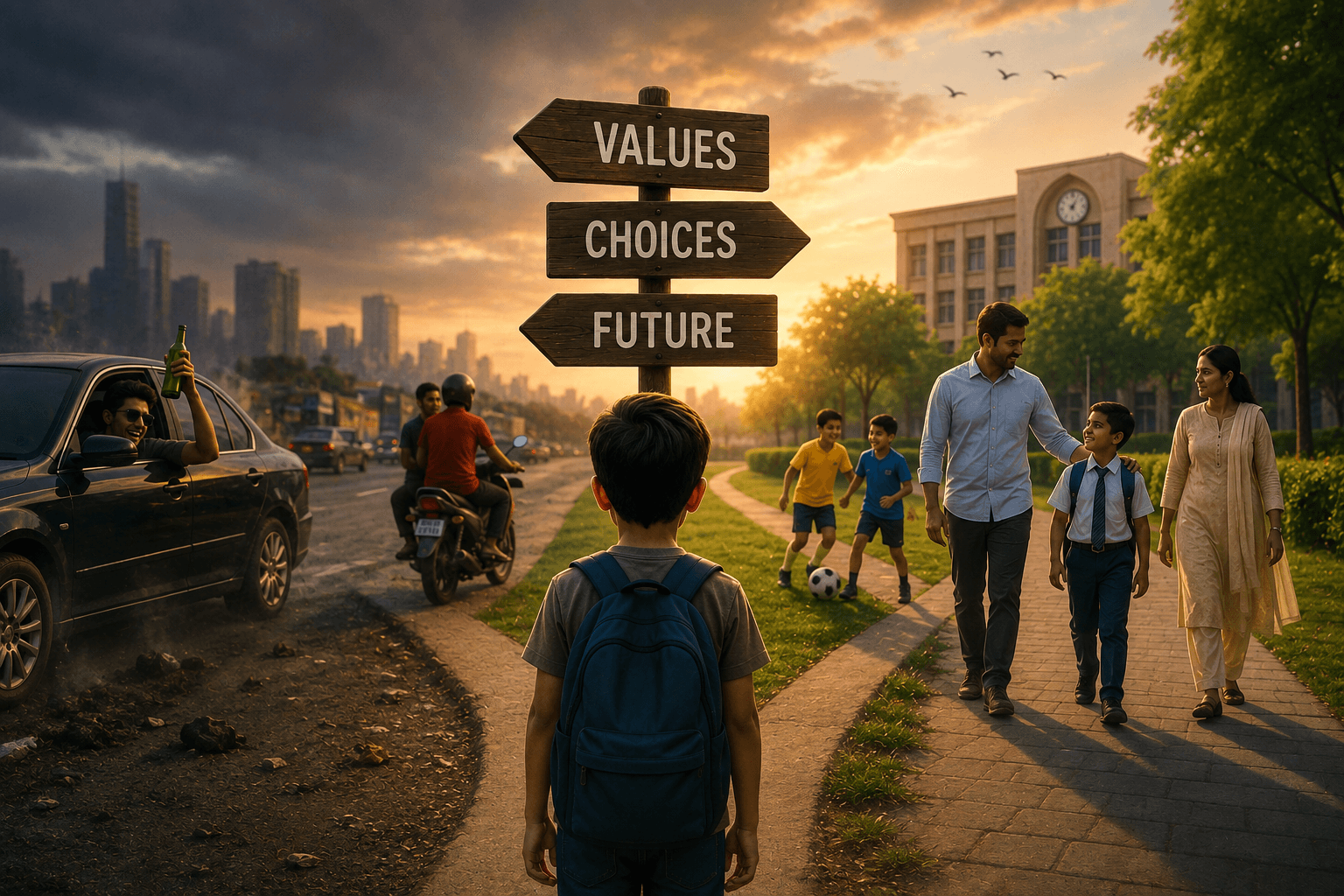
And then there is the third scene, which is not a headline at all. It happens every morning outside schools across this country. Parents dropping their children off on two-wheelers without helmets — neither the parent nor the child wearing one. Parents riding on the wrong side of the road because taking the correct side would cost them ninety extra seconds. Parents parking in the middle of the road, arguing with security guards, and honking at crossings.
What We Teach When We Are Not Teaching
I have seen children sitting in restaurants while the adults at the table drink, smoke, and use language that would get a student suspended if he repeated it in my classroom. Nothing illegal is happening. Nothing that technically violates a rule.
And yet, something is being transmitted. A child watching adults for three hours is learning what adulthood looks like. What celebration looks like. What “normal” sounds like. That is a lesson. Nobody planned it. Nobody wrote it on a board.
Education is what a child absorbs, whether we intended to teach it or not.
Inside the Classroom
Let me come to what I see with my own students.
Profanity has become punctuation. Words that were once considered unacceptable in front of an elder now arrive casually in the middle of a classroom sentence — with a small smile, because using them is considered cool. There is no shock left in them. And sometimes, no shame either.
Along with that, I see a steady erosion:
- No respect for elders. Not defiance exactly — something flatter than defiance. Indifference.
- No respect for time. Arriving late is no longer an apology-worthy event. It has become a lifestyle.
- No respect for space. For the room. For the people in it. For the fact that thirty other human beings are trying to concentrate.
- No sense of consequence. Everything is fixable. Everything is negotiable. Nothing is serious.
And here is the one that genuinely unsettles me. A student bending down to touch an elder’s feet and receive their blessing is now something to be laughed at. It has been re-labelled: Backward. Embarrassing. Not cool.
When exactly did receiving a blessing become a mark of being uncultured? I would like a date. I would like to know who decided it — and what we accepted in its place.
But You’ll Damage Their Mental Health
The moment anyone raises these issues, the conversation is often shut down with a single sentence: “You are being too strict.”
I want to be careful here, because this deserves care. Harshness, humiliation, and fear-based discipline damaged an earlier generation, and I have no interest in defending any of it. Children should never be afraid of the adults who teach them.
But somewhere between “stop terrorising children” and “never make a child uncomfortable,” we lost something important.
The absence of fear is a good thing. The absence of values is not. Somehow, we have managed to remove both together and call it progress.
So, Who Is Teaching?
Here is my honest audit.
Teachers are busy — syllabus, portions, revisions, board results, parent expectations. And there is no period on the timetable marked “How to Be a Person.”
Parents are busy — working, commuting, arranging tuitions, tracking homework, chasing marks, comparing their child with the neighbour’s child.
Educators and policymakers are busy — arguing about CBSE or State Board, ICSE or IB, NEP or the older framework. We have entire conferences discussing the container and very little discussion about the contents.
Everybody is busy. So let me ask again, plainly:
Then who is teaching?
Because somebody is. That vacuum did not remain empty. It got filled by a thirty-second reel. A YouTube Short. A random, confident stranger with a ring light explaining life, money, relationships, and success to a fourteen-year-old at one in the morning.
That is the faculty we have hired by default. We did not interview them. We do not know their qualifications. And we certainly cannot see their lesson plans.
The Subjects Nobody Teaches
Ask yourself which period on the timetable covers:
- Civic sense — the road, the queue, public spaces, litter, noise, and basic consideration for others.
- Common sense — judgement, proportion, and knowing what a situation calls for.
- Time management — not merely as a productivity hack, but as basic respect for other people’s time.
- Financial literacy — earning, saving, borrowing, the cost of things, and the value of things.
- Emotional regulation — sitting with frustration without breaking something or hurting someone.
- Respect — for elders, peers, staff, strangers, and one’s own self.
Not one of these is adequately represented in the conventional syllabus. And yet, all of them are part of the examination called adult life. And that examination is compulsory.
No Single Institution Can Do This
Let me be clear about what I am not saying. I am not saying schools should fix all of this. They cannot. Teachers alone cannot. Coaching centres alone cannot.
A child spends roughly six hours a day in school and eighteen hours everywhere else. If those eighteen hours contradict the six, the six lose. Every single time.
This requires all of us — parents, families, teachers, schools, neighbourhoods, workplaces, the shopkeeper, the traffic constable, the uncle at the wedding, the society we have built, and the culture we say we are proud of.
Where I Stand
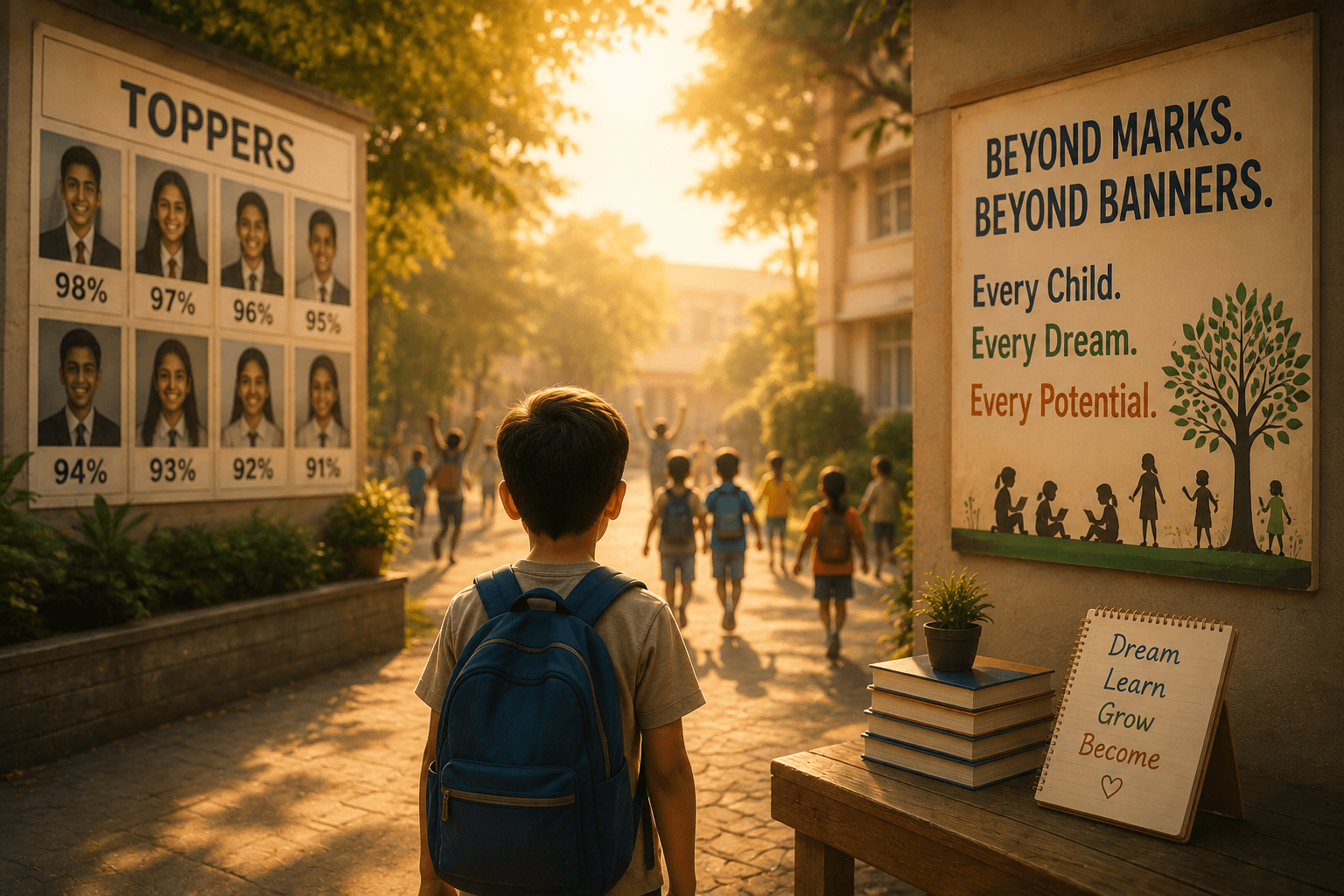
A student who scores 98% but cannot stand in a queue, cannot speak to an elder with respect, cannot arrive on time, cannot control their words, and cannot control a vehicle they were never old enough to drive — that student has been trained.
They have not necessarily been educated.
So I will leave the two questions where I started. And I am not asking them rhetorically. I am asking them of every parent. Every teacher. Every institution. And myself.
Where are we heading?
And: Who is teaching?
— Vedansh Naveen